
The 5R’s: REPAIR: The “Let’s Fix the Damage” Phase
Last time, we looked at the second phase of effective Gut Rehab:
The ‘REPLACE’ Phase
This highlighted the importance of restoring key digestive functions that are often overlooked:
Stomach acid.
Bile flow.
Digestive enzymes.
Motility.
Because if digestion upstream isn’t working properly…
Everything downstream is impacted.
Which again brings us back to…
The Sequence!
The magic of the 5R approach.
Today we move to the third phase in the framework I use when addressing Small Intestinal Bacterial Overgrowth (SIBO):
The ‘REPAIR’ Phase
And this is where we turn our attention to something many people with long-standing gut symptoms share:
Damage to the gut lining!
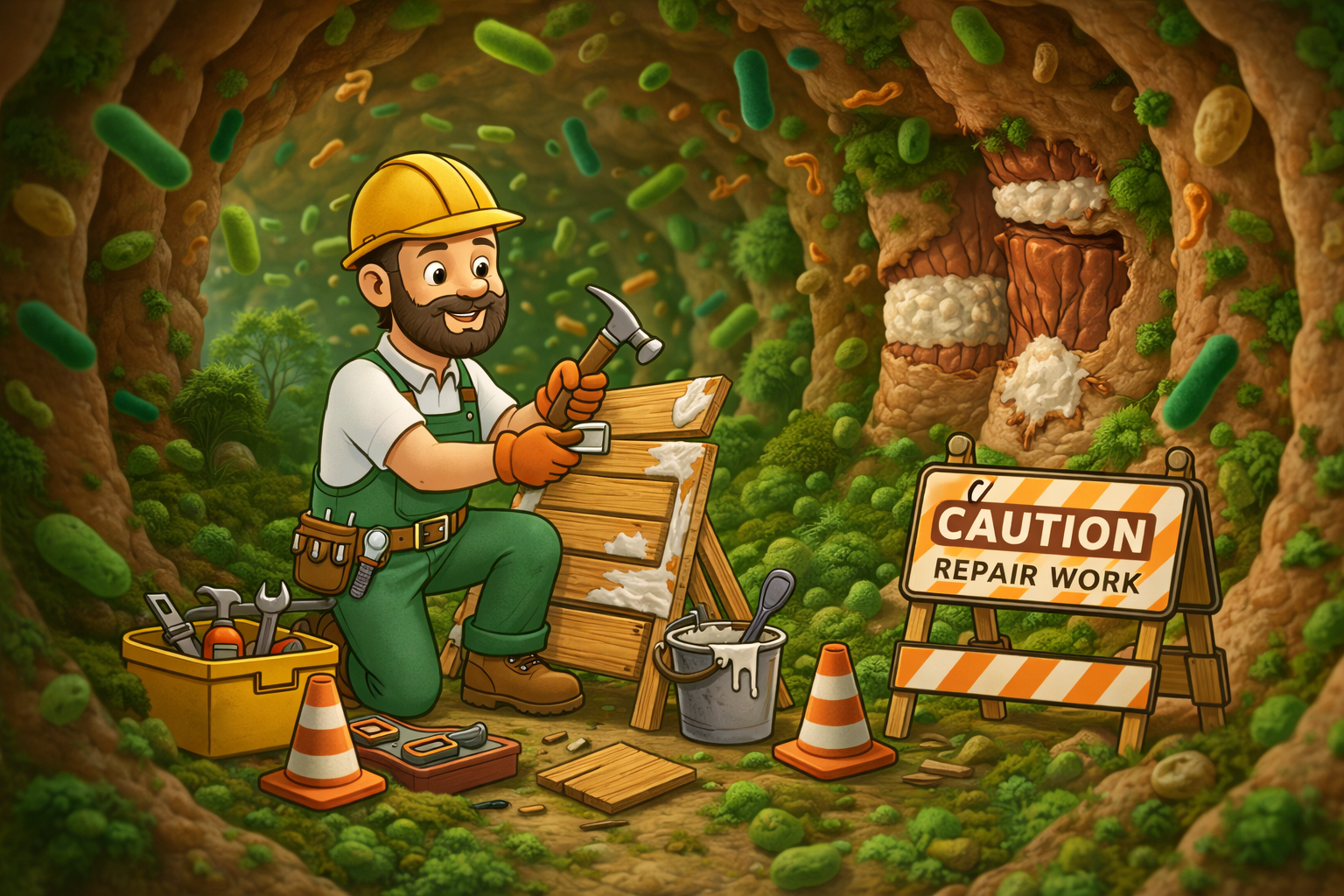
Not exactly like this but you get the idea...
Gut Inflammation: The Collateral Damage
When digestion is impaired, bacteria overgrow, fermentation increases and inflammation often follows.
Just like when you get a splinter in your finger, inflammation causes redness, pain, discomfort and increased immune activity.
In the gut, a similar process can occur.
Over time, ongoing irritation can begin to inflame the lining of the intestine itself.
And that lining is incredibly important.
It acts as a barrier between the outside world (food, microbes, toxins) and the inside of your body.
And when that barrier becomes compromised, problems can begin to escalate.
This is sometimes referred to as:
Increased intestinal permeability
Gut lining irritation
Barrier dysfunction
Or in less technical terms…
A gut that’s struggling to protect itself.
The Gut Lining: Your Internal Security System
The intestinal lining is only one cell thick!
Which is remarkable when you think about the workload it handles.
It must allow nutrients IN
While keeping pathogens and toxins OUT
To achieve this, it relies on several protective systems:
Tight junction proteins
Mucosal barrier layers
Secretory immune factors (IgA)
Anti-inflammatory signalling molecules
When chronic stress, infections, poor digestion, medications, alcohol or ultra-processed diets enter the picture…
That protective system can start to weaken.
And symptoms often follow -
Food sensitivities
Ongoing bloating
Irritable bowels
Fatigue
Immune reactivity
So before we think about rebuilding the microbiome…
We need to stabilise the terrain.
Repair Is About Calming and Rebuilding:
The goal of the REPAIR phase is simple:
Reduce inflammation
Support tissue healing
Restore barrier integrity
This allows the gut to regain some of its natural resilience.
Because again…
You cannot build a healthy ecosystem on top of damaged ground!
Key Nutrients That Support Gut Repair:
When clinically appropriate, several nutrients have been shown to support gut lining integrity.
These include:
L-Glutamine – a primary fuel source for intestinal cells
Zinc Carnosine – supports mucosal healing and barrier repair
Butyrate – a short-chain fatty acid that nourishes colon cells
Omega-3 fatty acids – anti-inflammatory support
Polyphenols (berries, olive oil, herbs) – antioxidant protection
These compounds help support the natural repair processes that the gut is constantly carrying out.
But supplementation is only part of the picture!
Repair Requires the Right Environment:
For repair to occur, the gut needs the right conditions.
That means looking at:
Sleep quality
Stress load
Alcohol intake
Ultra-processed food exposure
Blood sugar stability
Because chronic stress hormones alone can disrupt gut barrier function.
So sometimes the most powerful repair strategy isn’t a supplement.
It’s reducing the factors that are causing the damage in the first place.
Food as a Repair Tool:
Certain foods can also support the repair phase.
Examples include:
Slow-cooked meats and bone broths (collagen, glycine, L-glutamine)
Polyphenol-rich foods (berries, herbs, olive oil)
Anti-inflammatory spices (turmeric, ginger)
Omega-3 rich foods (wild fish, walnuts, flaxseed)
This isn’t about perfection.
It’s about creating an environment where healing becomes possible.
REPAIR Is About Stability
This phase isn’t flashy...
But in my experience its one that is commonly overlooked and its essential.
If the gut lining remains inflamed and compromised…
Any attempt to rebuild the microbiome becomes unstable.
Which is why REPAIR sits right before the next phase.
Next Week: Reinoculate
Next time we’ll move into Phase 4: REINOCULATE
Where we begin rebuilding microbial diversity in a gut that is now:
Less inflamed
Functioning better
More resilient
Which finally allows probiotics, fermented foods and fibres to actually do their job.
But for now, remember this:
Sometimes the gut doesn’t need more bacteria...It needs time to heal first.