
The 5R’s: REPLACE: The “Am I Missing Something?” Phase
Last time, we looked at the first phase of effective Gut Rehab:
The 'Remove' Phase
This highlighted the importance of...
"The Sequence"
Which is the magic of the 5R approach!
Today we move to the second phase in the framework I use when addressing Small Intestine Bacterial Overgrowth (SIBO):
The 'REPLACE' Phase
And this is where things get interesting!
Because sometimes the issue isn’t what’s there...
...It’s what’s missing!
Gut Symptoms Aren’t Always About “Too Much”
With SIBO, the conversation usually revolves around excess bacteria.
Too much fermentation.
Too much gas.
Too much bloating.
But very often, underneath that picture, there’s actually deficiencies...
Low stomach acid.
Suboptimal bile flow.
Insufficient enzyme production.
Impaired motility.
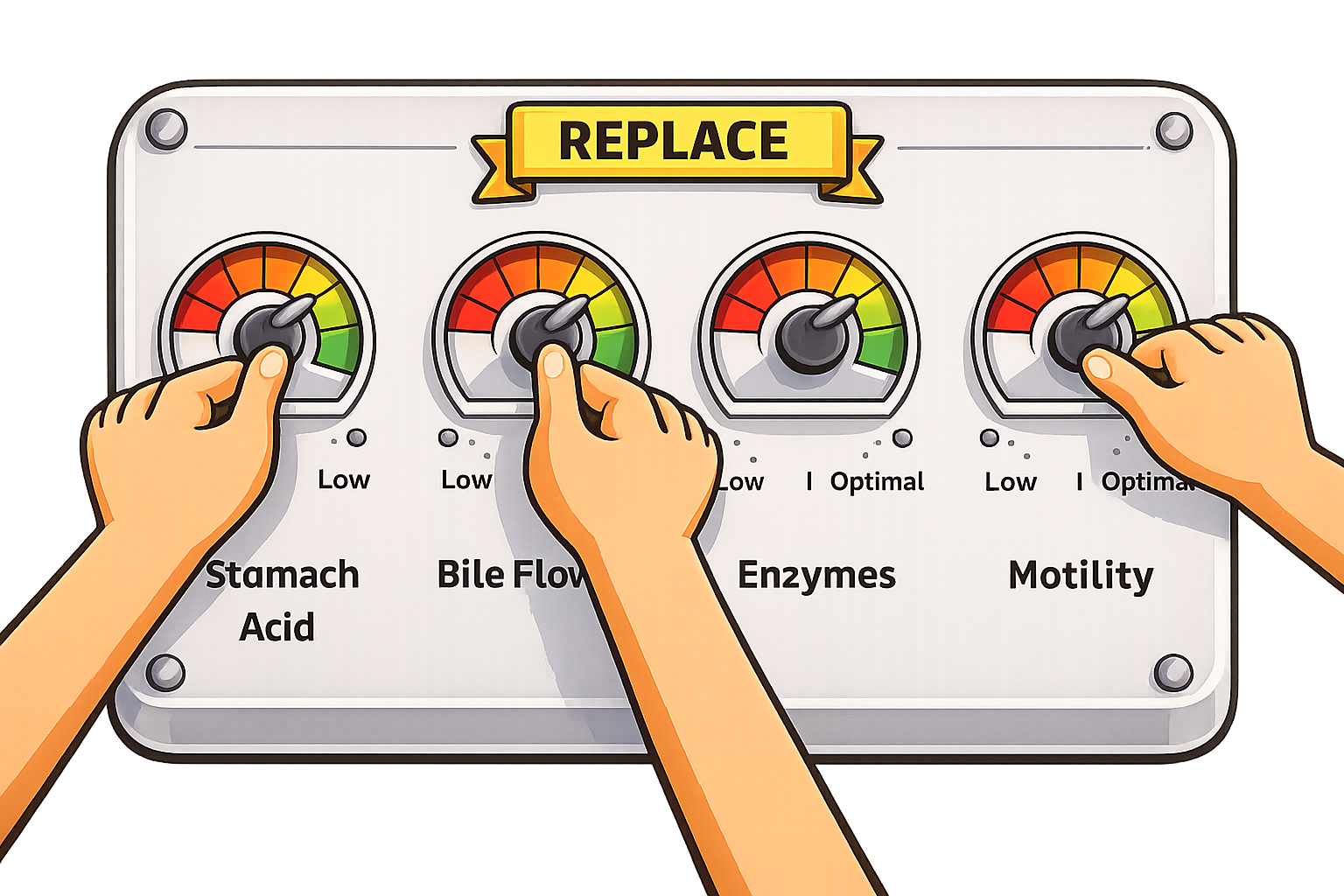
And when those are compromised, the small intestine becomes a very troublesome place!
Stomach Acid: The First Gatekeeper
“Stomach acid again, Ben?!”
Indeed.
And if you missed it, you can read more here:
A Tale of Digestion
But let’s look at it in this context.
Stomach acid isn’t just about breaking down food.
It:
Signals the pancreas
Triggers bile release
Helps sterilise incoming microbes
Activates digestive enzymes
When acid production is low, due to stress, age, medication (PPIs), chronic dieting, rushed eating, food isn’t properly processed.
Partially digested food together with reduced microbial sterilisation creates the perfect environment for excessive fermentation in the small intestine.
In SIBO cases, I often ask:
“Is this really an overgrowth problem?”
Or…
“Is this a digestion problem?”
Possible Interventions:
(when clinically appropriate)
Depending on presentation and testing, this may include:
Betaine HCl (short-term, supervised use)
Digestive enzyme therapy
Digestive bitters (e.g. Swedish bitters) to stimulate endogenous acid production
Addressing chronic stress before meals
Slowing meal pace / chewing protocols
Reviewing long-term PPI use with a GP
This is not about “throwing acid at the problem.”
It’s about restoring the signalling cascade.
Bile Flow: The Underestimated Antimicrobial
Bile is rarely discussed outside of gallbladder surgery.
But bile does far more than emulsify fats.
It:
Regulates microbial balance
Stimulates intestinal motility
Helps clear bacteria from the small intestine
Supports fat-soluble nutrient absorption
Sluggish bile flow can contribute to:
Fat malabsorption
Pale or floating stools
Constipation
Recurrent SIBO patterns
And yet most people never assess it!
(It does rely on good stomach acid levels, which is why stomach acid trumps everything)
Possible Interventions:
Where appropriate, this may involve:
Bitter foods (rocket, dandelion, radicchio)
Herbal bitters before meals
Taurine or glycine (bile conjugation support)
Phosphatidylcholine
Artichoke extract
Ensuring adequate dietary fat (extreme low-fat diets impair bile flow)
Addressing sedentary patterns
Again...this isn’t about "forcing bile production."
It’s about restoring rhythm.
Digestive Enzymes: Effective breakdown
If carbohydrates, proteins and fats aren’t properly broken down in the stomach and early small intestine, larger food particles can be feed upon by bacteria, which in SIBO, increases fermentation and gas.
That doesn’t mean everyone needs enzyme supplements.
But it does mean we assess:
Are you eating fast?
Are you stressed while eating?
Are meals irregular?
Is pancreatic output optimal?
Remember:
"Digestion starts in the brain...and cephalic phase stimulation is the first stage of digestion"
(As discussed here - A Tale of Digestion)
Possible Interventions:
Cooking your own food is the best way to stimulate the cephalic phase.
Broad-spectrum digestive enzymes (short-term support)
Targeted pancreatic enzymes when clinically indicated
Pre-meal stress management (breathing protocols)
Addressing chronic stress
Sometimes the intervention isn’t a capsule.
It’s how you eat.
Motility: The Missing Piece in SIBO
This is the BIG one.
The migrating motor complex (MMC) is the “cleaning wave” that clears residual debris and bacteria between meals.
It activates during periods of fasting...not so much with constant grazing.
If motility is impaired, due to stress, post-infectious changes, sleep disruption, constant snacking...bacteria start to accumulate.
"Can't we just get rid of the bacteria, Ben?"
Sure, you can remove bacteria, no problem at all...
But...
if you don’t restore movement...
They will return with a vengeance!
Possible Interventions:
Structured meal spacing (3–4 hours between meals)
Prokinetic support
Added Ginger
Dietary Fibre analysis
Magnesium citrate
Addressing vagal tone
Sleep optimisation
Motility is not just mechanical.
It’s neurological.
'REPLACE' is About Function:
This phase isn’t glamorous.
It doesn’t sell well on Instagram ("Shocking, I know")
But it’s fundamental and foundational.
Before we focus on repairing the gut lining or reinoculating with bacteria, we must ask:
Is the digestive system functioning as it should?
Because you cannot build resilience on top of dysfunction.
And you cannot out-supplement poor physiology.
My next blog will break down REPAIR where we address inflammation and gut lining integrity.