
How I Help Clients Lose Weight (1of3)
(Part One of Three)
Understanding Your Starting Point:
To begin a weight loss journey, you need to know where you’re starting from.
And yes… that does mean we need a little data.
To set my stall out early...
I don’t recommend long-term Calorie Counting.
It’s:
Mentally fatiguing
Often inaccurate over time
And can create a negative relationship with food
However...
Calories DO still matter for weight loss...they’re just not the whole story.
They are simply a unit of energy.
What determines how that energy is handled in the body depends on hormones, appetite signalling, digestion, stress, sleep, and muscle mass...
...All of which can be influenced by diet and lifestyle.
That’s why two people eating the same calories can have wildly different results.
"So, for that reason...we need to talk about..."

Step One: "Let’s get personal"
Working Out Your Basal Metabolic Rate (BMR):
Your Basal Metabolic Rate (BMR) is the amount of energy your body needs each day just to keep you alive.
We’re talking about the basics:
Breathing
Circulation
Brain function
Temperature regulation
Cellular repair
In other words, what your body would burn if you did absolutely nothing all day.
This matters, because for most people, BMR makes up the largest portion of daily energy use.
To make this easy, you can use this reliable online BMR calculator here to work out your own baseline:
https://www.diabetes.co.uk/bmr-calculator.html
Simply enter, your:
Gender
Age
Height
Weight
Once you’ve calculated your BMR, the next step is to take into consideration your activity level using the Harris–Benedict approach. This gives an estimate of the total number of calories you’d need to maintain your current body weight.
Use the option that best reflects your average week:
Little or no exercise = BMR × 1.2 = estimated daily calorie needs
Light exercise (1–3 days per week) = BMR × 1.375 = estimated daily calorie needs
Moderate exercise (3–5 days per week) = BMR × 1.55 = estimated daily calorie needs
Very active (6–7 days per week) = BMR × 1.725 = estimated daily calorie needs
Extra active (very active training plus a physical job) = BMR × 1.9 = estimated daily calorie needs
Let’s put this all together:
(I'll use myself as an example).
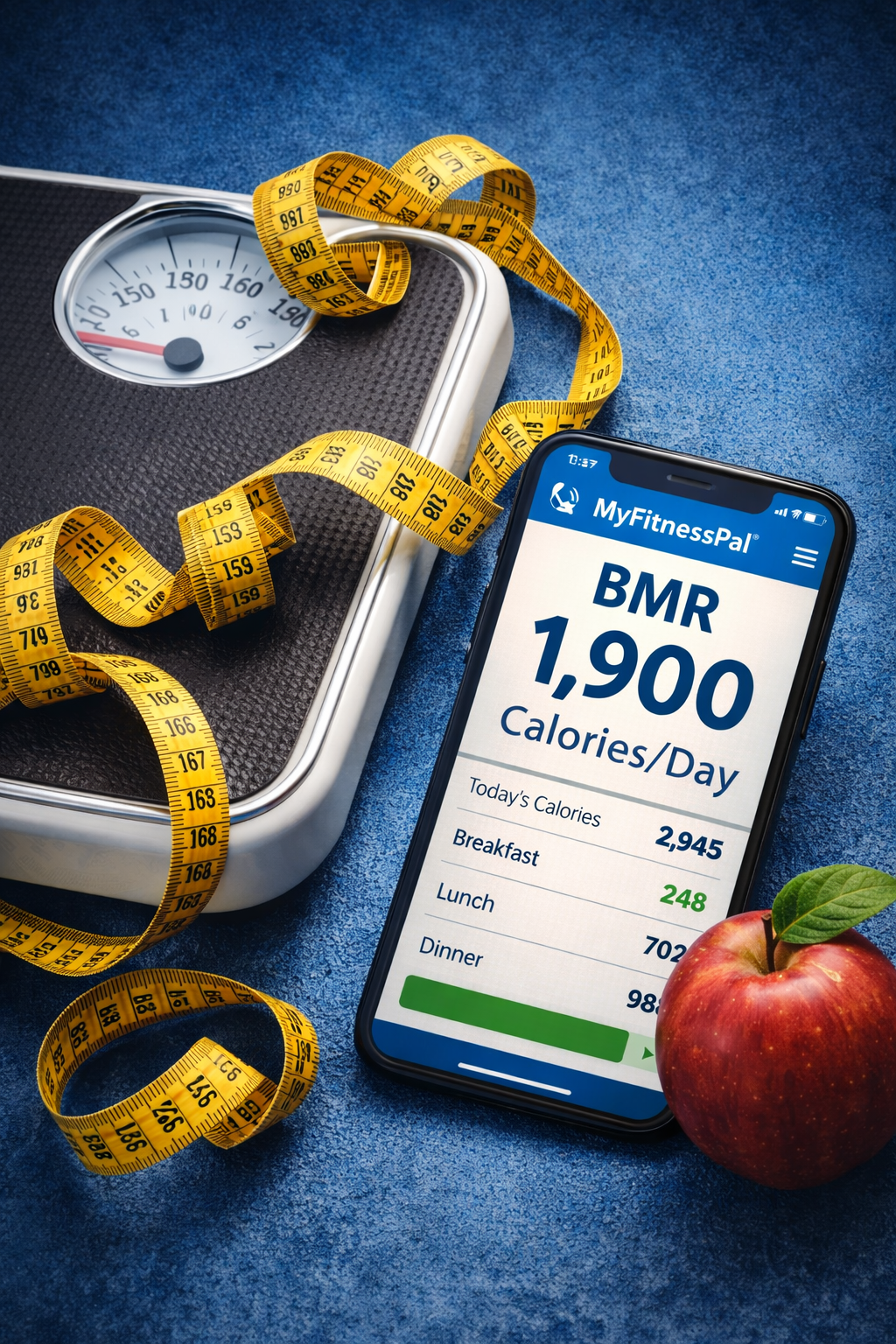
My BMR has been calculated at 1,900 calories per day.
This means:
If I did absolutely nothing all day, my body would still require around 1,900 calories just to function.
Next, I need to factor in my activity level using the Harris–Benedict multiplier.
Lets say I'm 'Moderately active' (active job and training 3-5x per week):
1,900 × 1.55 = 2,945 calories (rounded)
What this tells us:
This means my estimated total daily energy expenditure (TDEE) is around 2,945 calories per day.
In practical terms:
If I ate around this amount, I would likely maintain my current weight.
Eating consistently above this would push my weight up.
Eating below this, in a controlled and supportive way, would allow fat loss.
Again, this isn’t a target you must hit perfectly, it’s a reference point that helps remove guesswork.
Step Two: "Find out where you're at"
Now that you have your reference point, for weight loss we’d typically aim to be consistently 250–500 calories per day below this level.
Next...
Before making any changes, it’s important to understand what you’re currently doing, which is why I often recommend using something like MyFitnessPal for just one week.
MyFitnessPal allows you to log what you eat and drink, automatically estimating calories and nutrients by matching foods to a large database, so you can see how your intake compares to your needs over time.
Calorie Tracker & BMR Calculator to Reach Your Goals | MyFitnessPal
Why?
Because this isn’t about restriction, it’s about education.
Tracking for a short period helps you see:
How much you’re actually consuming.
Where the calories are coming from.
And, where there is wiggle room for change.
By the end of the week, you’ll have a clear idea whether your diet is high or low in protein or fibre, high or low in refined carbohydrates, or imbalanced when it comes to saturated and unsaturated fats.
This information then guides you on what actually needs attention.
Rather than overhauling your entire diet, the goal is to make small, targeted swaps to individual meals, nudging things in the right direction.
Yes, its a one-week investment...
Yes, its going to take some thought...
But it’s a simple, low-cost way to gather really valuable information that can make a real difference to your weight-loss journey.
"GIVE IT A GO!"
If you want further support with weight loss, feel free to book in for a discovery call!